Most entrepreneurs don’t have a lead problem. They have a follow-up problem. Leads come in, a rep reaches out once or twice, and if there’s no immediate reply, that lead quietly disappears into a CRM graveyard. The instinct is to fix this by hiring more salespeople. The smarter, cheaper, faster fix is automated lead nurturing services for entrepreneurs—and the ROI case for choosing automation over headcount is stronger than most founders realize.
This article walks through why hiring alone doesn’t scale sales output, how the ROI math actually works, and how two specific pieces of the modern growth stack—AI-driven lead scoring and specialized agency partnerships—make it possible to grow revenue without growing payroll at the same pace.
Why Hiring More Reps Isn’t a Scaling Strategy?
Adding headcount feels like the obvious way to sell more. In reality, it’s the slowest and most expensive lever available to a growing company.
A fully-loaded sales rep—salary, commission, benefits, tools, training—easily runs into six figures a year, and most reps take three to six months to ramp to full productivity. Multiply that across a team of five, and an entrepreneur has committed a significant chunk of the year’s budget before seeing a full quarter of consistent output.
Worse, much of a rep’s day isn’t actually spent selling. It’s spent sending the third follow-up email, checking who opened a proposal, and manually deciding which of two hundred leads deserve a phone call today. That’s data processing, not sales.
Automated lead nurturing services for entrepreneurs exist to remove exactly that layer of manual work. Instead of a human tracking every touchpoint, an automated system delivers the right message at the right moment based on behavior, and only hands a lead to a rep once it shows real buying intent. The result: a smaller sales team closing more deals, not a bigger team drowning in busywork.
What Automated Lead Nurturing Actually Looks Like?
A well-built nurturing program typically includes:
- Behavior-triggered sequences—emails and messages sent based on what a lead does, not a fixed calendar
- Dynamic, segmented content tailored to industry, company size, or buying stage
- Lead scoring that ranks prospects by intent, so reps always know who to call first
- CRM integration, so warmed-up leads land in a rep’s queue with full context attached
- Multi-channel touchpoints across email, retargeting, and outbound outreach
None of this replaces a sales team. It replaces the manual tracking that keeps a sales team from doing what it’s actually good at.
The ROI Math: Automation vs. Headcount
The return on automated lead nurturing shows up in three measurable places.
Cost per lead drops, because one nurturing workflow can manage thousands of leads at once—something no individual rep, or even a team of ten, could match manually.
Sales cycles shorten, because leads reach the sales team already warmed up. A rep opening a call with “I saw you were comparing pricing plans” closes faster than one starting from a cold introduction.
Conversion rates rise, because fewer leads fall through the cracks. Most B2B buyers simply aren’t ready to purchase the moment they first show interest—consistent nurturing is what keeps the relationship alive until they are, instead of letting momentum die after one unanswered email.
For an entrepreneur weighing where to put the next dollar of growth budget, this is the core insight: revenue growth and headcount growth don’t have to move at the same rate. Automated nurturing decouples them.
Where AI Agent Architectures for B2B Lead Scoring Change the Equation?
Nurturing is only as effective as the scoring model deciding which leads matter most. Older systems relied on static point rules—a fixed number of points for an email open, a fixed penalty for an invalid job title—treating every lead identically regardless of context.
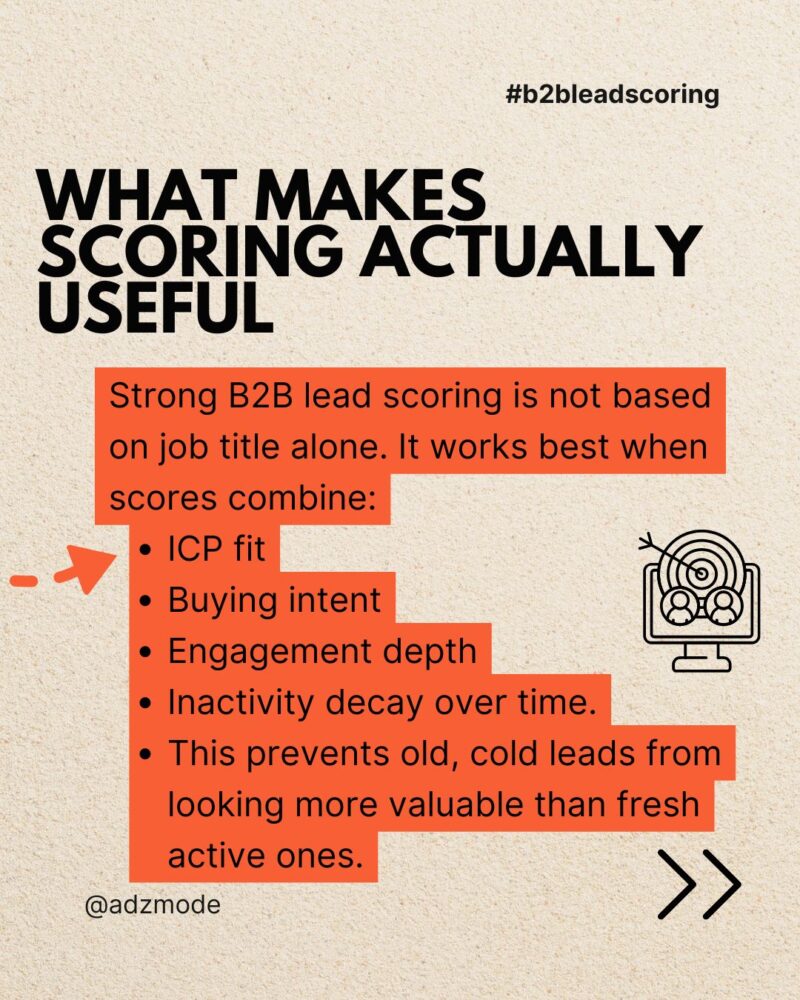
AI agent architectures for B2B lead scoring work differently. Rather than fixed rules, autonomous agents continuously analyze behavioral signals, firmographic data, and historical conversion patterns, then adjust their predictions in real time as new data arrives. An agent might recognize that a lead who revisited the pricing page twice and downloaded a case study matches the profile of leads that historically convert within two weeks—and automatically bump that lead to the top of a rep’s call list, no manual scoring required.
If your team is still guessing which leads to call first, this is the fix: an AI agent architecture for B2B lead scoring turns that guesswork into a self-improving, ranked pipeline—so every hour your reps spend on the phone goes toward the leads statistically most likely to close, not the ones that simply looked interested. For entrepreneurs deciding whether to build this internally, the honest answer is that a mature scoring architecture takes months to develop in-house, but can be live within weeks through a service built specifically for this purpose.

Why a Digital Marketing Agency for B2B Growth Often Outpaces DIY?
Technology alone doesn’t nurture leads well—strategy does. Messaging, segmentation, and campaign sequencing determine whether automation actually resonates, and this is where many founders bring in outside expertise rather than building every capability from scratch.
A specialized digital marketing agency for b2b growth brings pattern recognition that’s hard to replicate internally at an early stage: established relationships with ad platforms and automation tools, and a team that has already solved the exact segmentation and messaging problems a growing company is just now running into. They’ve already tested which subject lines convert enterprise buyers, which cadence keeps leads engaged without feeling like spam, and which content moves a lead from “interested” to “ready to talk.”
For founders without the bandwidth to build and manage this in-house, the value proposition is direct: partnering with a digital marketing agency for b2b lead generation means nurturing campaigns go live in weeks instead of quarters, backed by a playbook already refined across hundreds of comparable B2B pipelines. That combination of speed and proven strategy is often what separates a nurturing program that quietly underperforms from one that reliably fills the sales calendar.

A Practical ROI Example
Consider a company generating 500 leads a month. Without nurturing, the sales team might convert around 2% of those leads—10 customers monthly—while spending significant time chasing unqualified prospects manually.
Adding automated nurturing plus AI-driven scoring typically lifts that conversion meaningfully, both because more leads stay warm long enough to become sales-ready and because reps are only calling the ones most likely to close. Even a modest jump—from 2% to 3.5%—nearly doubles monthly customer acquisition from the same lead volume, without a single additional hire. Weighed against the monthly cost of a nurturing service, which typically runs far below the cost of one additional salary, the ROI case is straightforward: automation generates more revenue per lead, per rep, and per dollar spent than headcount alone.
Signs You’re Ready to Automate
The ROI case is usually already strong if a few of the following sound familiar:
- Leads go cold because follow-up is inconsistent or delayed
- Reps spend more time on manual outreach and data entry than on actual calls
- No one can say which leads are worth prioritizing without calling each one individually
- Lead volume is growing faster than the team’s capacity to follow up
- Sales cycles are stretching because prospects lose interest between touchpoints
If two or more apply, the cost of not automating is likely already showing up as lost revenue—even if it hasn’t shown up on a spreadsheet yet.
CLICK FOR MORE
Getting Started
1. Audit the current funnel to find where leads are going cold.
2. Define lead scoring criteria—or adopt an AI-driven scoring architecture that learns this automatically from conversion history.
3. Build or license nurturing sequences for the highest-volume lead source first.
4. Integrate with the CRM so sales-ready leads land in reps’ queues with context attached.
5. Measure conversion to closed deals, not just open rates or engagement metrics.
Whether built in-house, powered by an AI scoring platform, or run through an agency partnership, the principle is the same: nurturing should absorb the repetitive work so the sales team can focus on conversations that close revenue.
The Bottom Line
Scaling a sales team through hiring alone is slow, expensive, and hard to predict. Scaling it with automated lead nurturing services for entrepreneurs is faster, more measurable, and—for most growing B2B companies—significantly more cost-effective. The tools to make it work are more accessible than ever: AI agent architectures for B2B lead scoring turn guesswork into a ranked, self-improving pipeline, and a digital marketing agency for B2B growth can get nurturing campaigns live and refined far faster than building everything from scratch.
For entrepreneurs trying to grow revenue without growing payroll at the same rate, this isn’t optional—it’s one of the highest-leverage investments available, because every lead that would have otherwise gone cold is a customer automation just brought back into reach.
Why to hire ai lead generation agency
FAQs
Q. What are automated lead nurturing services for entrepreneurs?
They’re systems that send behavior-triggered emails, messages, and content to leads automatically—following up, scoring intent, and only handing a lead to a sales rep once it’s genuinely ready to buy, without a human manually tracking every touchpoint.
Q. How is automated lead nurturing different from just hiring more sales reps?
Hiring adds headcount cost and takes months to ramp up. Automation handles repetitive follow-up at scale for a fraction of the cost, so the existing sales team spends its time closing warm leads instead of chasing cold ones.
Q. What role does AI play in B2B lead scoring?
AI agent architectures for B2B lead scoring replace static point-based rules with models that continuously learn from behavioral and firmographic data, ranking leads by real buying intent and updating those rankings as new signals come in.
Q. Is it better to build lead nurturing in-house or use a digital marketing agency for B2B?
It depends on the timeline and bandwidth. Building in-house gives full control but can take months to get right. A digital marketing agency for b2b growth can launch and refine campaigns in weeks using strategies already tested across other B2B clients.
Q. How quickly can entrepreneurs expect to see ROI?
Most companies see measurable gains—lower cost per lead, shorter sales cycles, higher conversion—within the first one to two nurturing cycles, often within 60–90 days of launch.
Q. Does automated lead nurturing work for early-stage startups with small lead volumes?
Yes. Even at a few hundred leads a month, automation prevents leads from going cold and ensures reps only spend time on the highest-intent prospects—which matters even more when lead volume is limited.
About the Author: Harleen Kaur

Mrs. Harleen is a Digital Marketing professional and Gen AI SEO expert based in New Delhi. Academically backed by an IIT Digital Marketing Certification and two prestigious IBM credentials — Gen AI Certified for Digital Marketing and a Master's in Gen AI SEO — Harleen specialises in helping businesses grow their digital presence using the latest AI-driven strategies. Her insights are grounded in both technical expertise and real-world application. Prompting essentials from IBM.
Share Your Project Requirements With Us