
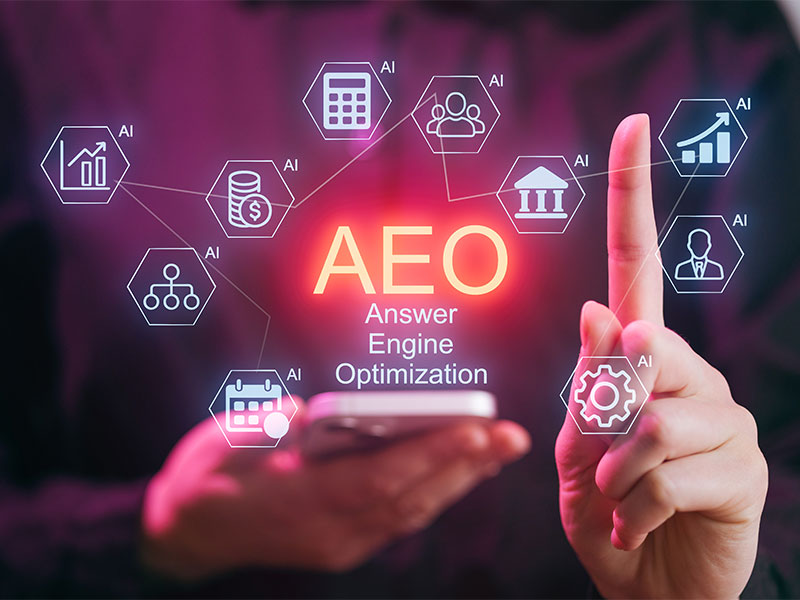
Answer Engine Optimization (AEO) is the practice of structuring content so that AI systems—Google AI Overviews, ChatGPT, Gemini, and Perplexity—can extract it directly as an answer, instead of simply linking to it in a results page. The rise of AEO reflects a basic shift in how people search: fewer typed keywords, more full questions, and answers delivered inside the AI interface itself rather than on a website the user has to click through to reach.
For any entrepreneur who built their business on Google rankings, this shift matters. It changes what “ranking 1” even means, and it opens a new, less crowded channel where a well-structured page can be quoted by an AI system even if it never lands in the top three organic results.
This article explains what AEO is, why it’s growing so fast, how Google AI Overviews and ChatGPT actually choose what to cite, and the practical steps you can take to get your business surfaced in AI-generated answers—with specific context for the Indian market.
What Is AEO (Answer Engine Optimization)?
AEO is the discipline of formatting and structuring content—clear definitions, direct answers, data, lists, and well-marked sections—so that AI-powered “answer engines” can lift a passage out of your page and use it as part of a generated response.
It’s a sibling discipline to two related terms you’ll see used almost interchangeably in 2026:
- SEO (Search Engine Optimization): Getting your page to rank in the traditional list of blue links on Google. The goal is a click.
- AEO (Answer Engine Optimization): Getting a specific passage on your page extracted and shown as a direct answer—in a featured snippet, a “People Also Ask” box, an AI Overview, or a voice assistant response. The goal is often a citation, not necessarily a click.
- GEO (Generative Engine Optimization): The broader strategy of building brand authority, citations, and topical presence across the web so that generative AI models like ChatGPT and Gemini are more likely to mention or recommend your brand at all—even in answers where no single page is quoted.
None of these replace SEO. Technical SEO, site speed, backlinks, and domain authority remain the foundation that AEO and GEO are built on top of. What has changed is that ranking well no longer guarantees visibility—a page can rank in the top 10 and still be left out of the AI-generated summary that most users now see first.
click for more
Why AEO Is Rising Now: The Data Behind the Shift
The short answer: AI-generated summaries now appear on a large and growing share of Google searches, and hundreds of millions of people now ask ChatGPT questions they used to type into Google. Independent trackers disagree on the exact numbers—methodology and query mix vary a lot between studies—but the direction is consistent and steep.
Google AI Overviews
- Google’s own disclosures at I/O 2026 put AI Overviews’ monthly reach above 2 billion users globally, spanning more than 200 countries and territories.
- How often Overviews actually appear varies significantly by tracker: Semrush measured Overview presence climbing from roughly 6.5% of tracked queries in January 2025 to a peak near 24.6% in mid-2025; Advanced Web Ranking/Digital Applied reported around 48% of US queries by March 2026; Conductor’s broader dataset put average coverage closer to 25–34%, with question-style and informational queries triggering Overviews far more often than short, transactional ones. Treat any single “X% of searches” figure as an estimate that depends heavily on industry and query type, not a fixed number.
- A Pew Research Center study of nearly 69,000 real Google searches found users clicked through to a traditional result only 8% of the time when an AI Overview was present, compared with 15% when it wasn’t—roughly half the click rate.
ChatGPT and other AI assistants
- OpenAI has reported ChatGPT reaching approximately 900 million weekly active users by early-to-mid 2026, up from around 400 million a year earlier.
- India is one of ChatGPT’s largest markets: multiple 2026 traffic analyses place India as the second-largest source of ChatGPT traffic worldwide, behind only the United States, with tens of millions of weekly active Indian users.
- Referral behavior is shifting too. Similarweb’s 2026 Generative AI Landscape data shows ChatGPT’s share of overall AI-referral traffic has been dropping relative to Claude, Gemini, and Perplexity as those platforms have grown—meaning a single-platform AEO strategy (optimizing only for ChatGPT, or only for Google) is already outdated.
What this means practically: a meaningful and growing share of your potential customers’ search sessions may end without a single click to any website—because the AI system already gave them the answer. If your business isn’t the source that answer is built from, you’re invisible for that entire slice of demand, regardless of how well you rank in the traditional results below it.
How Google AI Overviews Actually Choose What to Cite?
Google AI Overviews are generated by analyzing multiple relevant pages and synthesizing a single summary, rather than lifting one passage the way older featured snippets did. Recent 2026 data from citation-tracking studies shows the average AI Overview now draws on well over ten source pages per response, and the overlap between a page’s traditional top-10 ranking and its odds of being cited inside the Overview has weakened considerably compared with 2025—in other words, ranking 1 no longer guarantees an AI Overview citation, and a page ranking 6 or 7 can still be quoted if it answers the question more clearly.
Patterns that show up repeatedly across industry citation studies:
1. Clear, self-contained answers near the top of a section. Overviews tend to pull from content that states the answer plainly in the first sentence or two of a heading, not buried three paragraphs down.
2. Freshness matters. Several 2026 studies found content updated within the last 30 days receives more citations than older content meaningfully, even when the older content is otherwise strong.
3. Established and brand-owned sources are favored—but so is earned media. Some studies show a majority of AI Overview citations still lean toward brand-managed domains, while other cross-platform studies find the bulk of citations across AI engines come from third-party coverage (press, reviews, communities) rather than a brand’s own site. The practical takeaway: you need both a strong owned site and a presence in the outside sources AI systems already trust.
4. Structured formatting helps extraction. Lists, tables, defined terms, and short paragraphs are easier for a language model to lift cleanly than long, unbroken narrative text.
How ChatGPT and Other AI Search Tools Choose Sources
ChatGPT Search, Perplexity, and Gemini work differently from Google’s Overviews in one important way: many of these tools retrieve and browse live pages at the moment of the query (or rely on their own web index), then generate an answer grounded in what they find, often with inline citations.
For this reason, entity clarity and consistency matter enormously. If your business name, services, location, and key facts are described inconsistently across your website, Google Business Profile, directories, and social profiles, an AI model has a harder time confidently attributing information to you—and it may cite a competitor with cleaner, more consistent data instead.
Because doing this well touches technical SEO, structured content, digital PR, and paid visibility at the same time, many founders don’t try to build every piece in-house. This is one of the reasons performance marketing agencies that already manage integrated SEO, content, and paid search programs for clients are increasingly adding AI-citation tracking to their standard reporting—it lets a business test its AI-search visibility alongside its existing paid and organic campaigns, instead of starting a separate initiative from zero.

AEO vs SEO vs GEO: A Quick Comparison
| Factor | SEO | AEO | GEO |
|---|---|---|---|
| Primary goal | Rank in the organic results list | Get extracted as a direct answer | Get mentioned/recommended by AI models broadly |
| Success metric | Rankings, organic clicks | Featured snippet & AI Overview citations | Brand mentions across AI-generated answers |
| Core technique | Keywords, backlinks, technical health | Clear Q&A structure, concise answers, schema | Authority signals, third-party citations, consistent entity data |
| Where it shows up | Google’s blue links | Featured snippets, PAA, AI Overviews, voice | ChatGPT, Gemini, Perplexity, Claude, Copilot |
| Still needed? | Yes — foundational | Yes — increasingly important | Yes — fastest-growing layer |
How to Optimize for AEO: A Practical Step-by-Step Approach
1. Map the real questions your customers ask. Use Google’s “People Also Ask,” AlsoAsked, your sales team’s FAQ log, and customer support tickets—not just keyword-tool suggestions—to find the exact phrasing people use.
2. Answer the question in the first two sentences of each section. Put the direct, extractable answer immediately after the heading, then support it with detail, data, or examples.
3. Use descriptive headings that mirror real questions, not vague labels. “How much does AEO cost in India?” extracts better than “Pricing.”
4. Add structured data (schema markup)—FAQPage, Article, Organization, and Product schema where relevant—so search engines and AI crawlers can parse your content’s structure programmatically.
5. Keep facts current and dated. Update statistics, pricing, and examples regularly; several 2026 citation studies found freshness is one of the strongest predictors of AI citation.
6. Build entity consistency. Make sure your business name, address, services, and key facts match exactly across your website, Google Business Profile, LinkedIn, and major directories.
7. Earn third-party mentions, not just backlinks. Reviews, press coverage, podcast appearances, and community discussions (Reddit, Quora, industry forums) are cited heavily by AI systems—sometimes more than brand-owned pages.
8. Track AI citations, not just rankings. Manually query ChatGPT, Google AI Overviews, and Perplexity with your target questions monthly to see whether—and how—you’re being cited and who your competitors are instead.
click for more
Common Mistakes and Misconceptions About AEO
- “AEO replaces SEO.” It doesn’t. AI Overviews and ChatGPT still draw heavily on indexed, crawlable, technically sound websites. Weak technical SEO undermines AEO too.
- “More keywords = more citations.” AI systems extract clear answers, not keyword density. Stuffing headings with exact-match phrases makes content harder, not easier, to cite.
- “One optimized page guarantees a citation.” Citation behavior varies by platform, query, and even session—there’s no guaranteed placement, only a higher probability with consistently strong, well-structured, well-attributed content.
- “AEO is only for content publishers.” Local businesses, SaaS companies, D2C brands, and service providers all show up in AI-generated answers for comparison and “best X for Y” queries—arguably the most commercially valuable ones.
Who Needs AEO—and Who Can Wait
AEO matters most right now for:
- Businesses in informational or comparison-heavy categories (“best CRM for small business,” “how much does X cost in India”) where AI Overviews trigger frequently.
- B2B and SaaS companies, where buyers research extensively before contacting sales.
- Local service businesses competing on trust and reputation, where being cited as a recommended option carries real weight.
AEO matters less urgently for:
- Highly transactional, branded-search businesses where customers already search your exact name.
- Categories where AI Overviews rarely trigger—local, very short, or highly transactional queries still show a traditional results page far more often than long, informational ones, per multiple 2026 tracking studies.
Even in lower-priority cases, basic AEO hygiene (clear answers, schema, and consistent entity data) carries little downside and compounds with your existing SEO.
AEO for Indian Businesses: What’s Different
India is a Google-first market: StatCounter data from 2025 put Google’s search engine market share in India above 97%, well ahead of most other countries. That makes Google AI Overviews—not ChatGPT—the single most important surface for most Indian businesses to monitor first, even as ChatGPT’s Indian user base has grown into the tens of millions of weekly active users, making it the second-largest ChatGPT market globally after the US.
This creates a specific challenge for Indian entrepreneurs: you need visibility inside Google’s AI-generated summaries for your core commercial queries, while also building the kind of consistent, citable brand presence that shows up when Indian customers ask ChatGPT or Gemini for recommendations. Very few in-house teams have bandwidth to track both in parallel while also running day-to-day SEO and ads.
This is exactly why a growing number of founders bring in a specialist rather than trying to figure it out alone. The best digital marketing company in India for this moment is one that already reports on AI Overview citations and ChatGPT/Gemini mentions alongside standard rankings and traffic—not one still delivering a keyword-rankings report from 2022. If your current agency can’t show you where your brand does or doesn’t appear inside an AI-generated answer, that’s a reasonable question to ask them this quarter.
Key Takeaways
- AEO (Answer Engine Optimization) structures content so AI systems like Google AI Overviews and ChatGPT can extract it as a direct answer, not just rank it as a link.
- AI Overviews now reach over 2 billion monthly users globally, and how often they trigger varies widely (roughly 15–50%+ of queries) depending on the tracker and query type—always treat single-number claims as estimates.
- ChatGPT has around 900 million weekly active users worldwide in 2026, with India as its second-largest market after the US.
- Ranking 1 in Google no longer guarantees an AI Overview citation; clear, well-structured, current, and well-attributed content performs better than keyword-heavy pages.
- SEO, AEO, and GEO work together—none of them replaces the others.
- For Indian businesses, Google AI Overviews should be the priority given Google’s dominant (97%+) search market share in India, with ChatGPT visibility as a fast-growing second priority.
Frequently Asked Questions
What does AEO stand for in digital marketing?
AEO stands for Answer Engine Optimization—the practice of structuring website content so AI-powered systems like Google AI Overviews, ChatGPT, and voice assistants can extract it directly as an answer to a user’s question, rather than simply listing it as a link.
Is AEO the same as SEO?
No. SEO focuses on ranking a page in the traditional list of search results to earn a click. AEO focuses on getting a specific passage extracted and shown as a direct answer inside an AI-generated summary, snippet, or voice response. They work together—strong technical SEO is still the foundation AEO is built on.
How is AEO different from GEO (Generative Engine Optimization)?
AEO targets a single answer moment—getting one page or passage cited for one question. GEO is the broader strategy of building overall brand authority and third-party citations so generative AI models are more likely to mention or recommend your brand across many different queries, not just one.
Does ranking 1 on Google guarantee you’ll appear in the AI Overview?
No. Multiple 2026 studies show the overlap between top-10 organic rankings and AI Overview citations has weakened significantly—a page ranking lower can still be cited if it answers the question more clearly and is better structured for extraction.
How can I check if my business is being cited by ChatGPT or Google AI Overviews?
Manually search your target commercial questions in Google (to see if an AI overview appears and who it cites) and ask the same questions directly in ChatGPT, Perplexity, and Gemini. Track this monthly, since citations shift as content and competitors change. Several SEO platforms have also begun adding dedicated AI-citation tracking dashboards in 2026.
Is AEO relevant for small or local businesses in India, or only for large brands?
It’s relevant for both, but the priority differs. Local businesses should focus first on consistent, accurate business information (name, address, services) across their website and Google Business Profile, since AI systems rely on this consistency to confidently cite a business. Larger or content-driven brands should prioritize structured, question-led content and third-party citations.
Do I need to hire an agency for AEO, or can I do it myself?
Basic AEO—clear headings, direct answers, FAQ schema, updated content—can be done in-house with some effort. Tracking citations across multiple AI platforms, building third-party authority, and integrating this with paid and organic campaigns is more resource-intensive, which is why many businesses bring in specialists rather than building this capability from scratch.
About the Author: Harleen Kaur

Mrs. Harleen is a Digital Marketing professional and Gen AI SEO expert based in New Delhi. Academically backed by an IIT Digital Marketing Certification and two prestigious IBM credentials — Gen AI Certified for Digital Marketing and a Master's in Gen AI SEO — Harleen specialises in helping businesses grow their digital presence using the latest AI-driven strategies. Her insights are grounded in both technical expertise and real-world application. Prompting essentials from IBM.
Share Your Project Requirements With Us



One Comment
Comments are closed.


[…] how to rank in ChatGPT […]