

Achieving hyper-personalization at scale using AI requires four connected layers working together: a unified customer data foundation, AI models that predict intent and segment behavior in real time, dynamic content generation that adapts per individual, and an orchestration layer that delivers the right message on the right channel at the right moment—automatically, for every customer, not just your top-tier accounts.
This is a different problem than basic personalization (like inserting a first name into an email subject line). Hyper-personalization at scale means treating every single customer interaction as an opportunity for a 1:1 experience, across thousands or millions of users simultaneously, without a human manually configuring each one. That’s only possible with AI doing the heavy lifting on data analysis, prediction, and content assembly.
The business case is well established. McKinsey research has found that companies that build effective personalization capabilities generate significantly more revenue than peers who don’t, and separately reports that personalization can lower customer acquisition costs by as much as 50%, lift revenue by 5–15%, and increase marketing ROI by 10–30%. Consumer expectations have shifted accordingly—McKinsey also found that 71% of consumers expect personalized interactions from brands, and 76% report frustration when they don’t get them. This guide breaks down exactly how to build that capability, step by step, without needing an enterprise-sized data science team.
What Is Hyper-Personalization at Scale?
Hyper-personalization at scale is the practice of using AI and real-time data to deliver individually tailored content, offers, and experiences to every customer, across every channel, without manual effort per customer.
It differs from traditional personalization in three ways:
- Granularity: Traditional personalization segments customers into broad groups (“women aged 25–34”). Hyper-personalization treats each customer as a segment of one, based on their actual behavior, not just demographics.
- Real-time responsiveness: Instead of updating a customer’s profile weekly or monthly, AI-driven systems adjust recommendations and messaging based on actions taken minutes or seconds ago—a product viewed, a cart abandoned, a support ticket raised.
- Scale without linear cost: A human marketing team can meaningfully personalize for a few hundred key accounts. AI-driven hyper-personalization applies that same level of individual attention across an entire customer base of any size, because the models—not people—are doing the segmentation and content-matching.
Why Hyper-Personalization Matters for Business Growth?
Hyper-personalization matters because it directly affects three levers business owners care about: acquisition cost, conversion rate, and customer lifetime value.
According to McKinsey’s research on personalization, businesses that excel at it can:
- Reduce customer acquisition costs by as much as 50%
- Lift revenue by 5–15%
- Increase marketing ROI by 10–30%
On the customer side, expectations have moved from “nice to have” to a baseline requirement. McKinsey found that 71% of consumers expect personalized interactions, and 76% get frustrated when brands fail to deliver them. Separately, Epsilon’s 2023 consumer research found that 80% of consumers are more likely to make a purchase when brands offer personalized experiences.
Put together, these numbers mean two things for a business owner: personalization is now a retention and conversion mechanism, not just a “brand nice-to-have,” and failing to personalize is now actively working against you, not just neutral.

The Core Components of an AI-Powered Hyper-Personalization Strategy
An AI-powered hyper-personalization strategy is built on four components: unified data, predictive AI models, dynamic content, and cross-channel orchestration.
1. A Unified Customer Data Foundation
Before AI can personalize anything, it needs one accurate, real-time view of each customer—not fragmented data sitting separately in your CRM, e-commerce platform, email tool, and support software. This is typically achieved through a Customer Data Platform (CDP) that stitches together first-party data (purchases, browsing behavior, support interactions, app usage) into a single customer profile.
2. Predictive AI Models
Once data is unified, machine learning models analyze patterns to predict what a customer is likely to want next—a product recommendation, the right time to send an offer, or the risk that a customer is about to churn. These models improve continuously as more behavioral data flows in.
3. Dynamic Content Generation
Static content can’t scale to millions of individual variations. AI-generated or AI-assembled content—product descriptions, subject lines, homepage banners, app content blocks—is built from modular components that the system reassembles per user, based on what the predictive models indicate will resonate.
4. Real-Time Orchestration Across Channels
The final layer decides which channel (email, SMS, app push, on-site banner, ads) and which moment to deliver the personalized message, based on where the customer is most likely to engage right now. This requires systems that talk to each other in real time, not batch-processed overnight.
How to Achieve Hyper-Personalization at Scale: A Step-by-Step Framework
Achieving hyper-personalization at scale follows a five-step sequence: consolidate your data, define clear use cases, choose the right AI and automation tools, start with a pilot segment, and scale based on measured results.
1. Audit and consolidate your customer data
Identify every system holding customer data (CRM, e-commerce, support, ads) and map how it will flow into a single unified profile, typically via a CDP or a well-integrated data warehouse.
2. Define 3–5 specific personalization use cases first
Don’t try to personalize everything at once. Start with clear, measurable use cases—e.g., product recommendations on-site, cart abandonment sequences, or churn-risk win-back campaigns.
3. Select AI and automation tools that fit your data maturity
Off-the-shelf platforms (Klaviyo, HubSpot, Salesforce Marketing Cloud, Adobe) work well for many mid-sized businesses. Larger, more complex operations often need custom-built systems that integrate proprietary data and workflows an off-the-shelf tool can’t handle out of the box.
4. Pilot with a defined customer segment
Run your chosen use case on a smaller, measurable segment first—this lets you validate lift in conversion or retention before committing budget to a full rollout.
5. Measure, refine, and scale gradually
Track the specific metric each use case is meant to move (conversion rate, AOV, churn rate), refine the AI model’s inputs based on results, and expand to additional segments and channels once the pilot shows a clear positive return.
Build vs. Buy: When Off-the-Shelf Tools Aren’t Enough
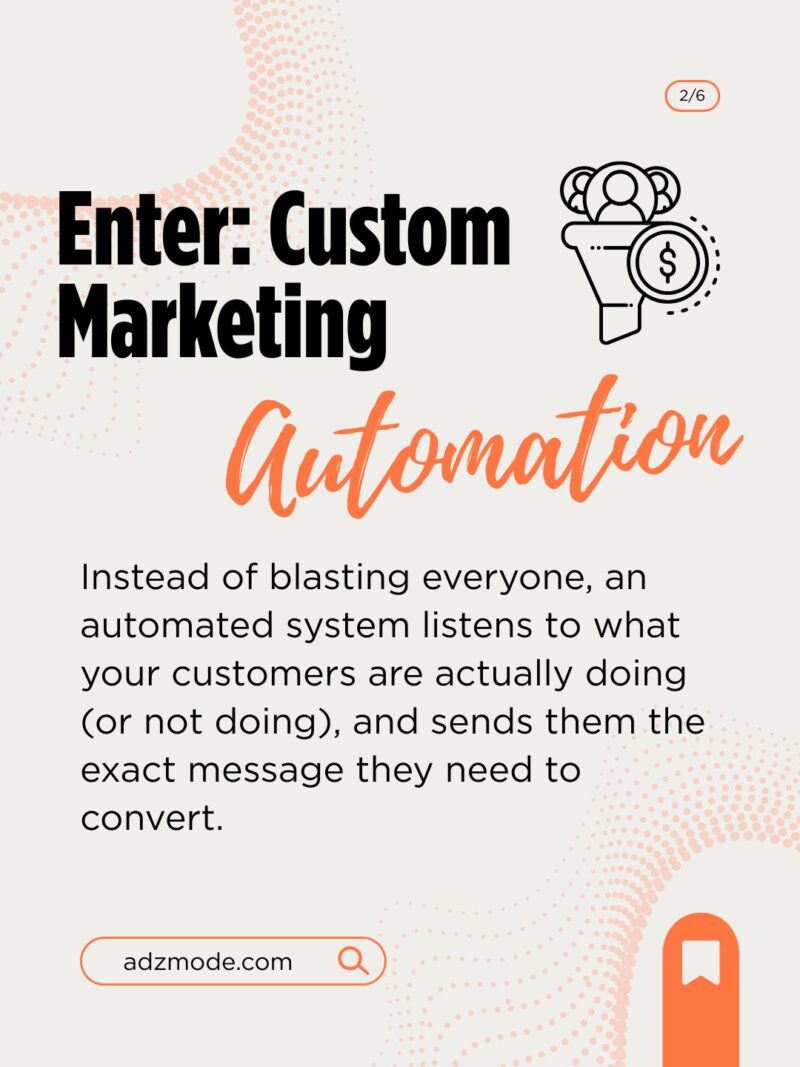
Off-the-shelf marketing platforms work well until your personalization logic, data structure, or channel mix becomes too complex for their pre-built workflows—at that point, a custom-built system usually outperforms a generic one.
Most businesses starting out should use existing platforms rather than building from scratch; it’s faster and cheaper. But as personalization use cases multiply—combining behavioral data, inventory data, pricing logic, and multi-channel delivery rules that don’t fit a vendor’s standard templates—pre-built platforms start to become the bottleneck rather than the enabler.
This is the point where custom marketing automation systems genuinely earn their cost. A custom-built system is designed around your specific data architecture and business logic from day one, instead of forcing your business to adapt to a vendor’s generic workflow limitations. If you’ve noticed your team building workarounds, exporting data manually between tools, or hitting the ceiling of what your current platform’s “rules engine” can express, that’s usually the clearest sign it’s time to invest in a custom marketing automation system built specifically around how your business actually operates—not a template built for the average customer.

Common Mistakes When Scaling AI Personalization
The most common mistakes businesses make are personalizing too many use cases at once, relying on stale or fragmented data, and treating AI personalization as a one-time setup instead of a continuously improving system.
- Trying to personalize everything on day one. This spreads data, budget, and attention too thin to prove any single use case works before moving to the next.
- Feeding AI models fragmented or outdated data. If customer data sits in silos or updates only weekly, the “real-time” advantage of AI personalization disappears—predictions are based on stale behavior.
- Treating it as a one-time project. AI models degrade in accuracy if they’re not retrained on fresh data and monitored for performance; personalization requires ongoing management, not a single implementation phase.
- Ignoring privacy and consent requirements. Aggressive personalization built on data collected without clear consent creates both legal risk and customer distrust—the opposite of the loyalty personalization is meant to build.
- Measuring vanity metrics instead of business outcomes. Open rates and click-throughs matter less than whether personalization is actually moving conversion rate, retention, or average order value.
Off-the-Shelf Tools vs. Custom Systems: A Quick Comparison
| Factor | Off-the-Shelf Platform | Custom Marketing Automation System |
|---|---|---|
| Setup speed | Fast—days to a few weeks | Slower—weeks to a few months |
| Cost structure | Predictable subscription pricing | Higher upfront investment, lower long-term ceiling |
| Flexibility | Limited to vendor’s rules engine and integrations | Built around your exact data and business logic |
| Best suited for | Businesses starting out or with standard use cases | Businesses with complex data, pricing, or multi-channel logic |
| Scalability ceiling | Often hits limits as complexity grows | Scales with the business, since it’s purpose-built |
When to Bring In Outside Expertise?
Bringing in outside expertise makes sense when your team has the data and tools in place but lacks the specialized skill set to turn them into a running, optimized personalization program—this is usually a faster and cheaper path than hiring and training an in-house team from scratch.
Building an AI-driven personalization engine touches multiple specialized disciplines at once: data engineering, marketing automation, paid media, and conversion optimization. Very few in-house marketing teams have deep expertise across all of them, and hiring individually for each skill set is expensive and slow, especially for a mid-sized business that needs results within a quarter, not a year.
This is exactly the gap experienced performance marketing agencies are built to close. A good performance marketing agency doesn’t just run your ads—the strongest ones bring hands-on experience setting up AI-driven segmentation, integrating marketing automation with paid campaigns, and continuously optimizing based on real conversion data across dozens of client accounts, not just theory from a single in-house team’s trial and error. If your business has the budget and the data but not the specialized bandwidth to execute hyper-personalization correctly, partnering with a performance marketing agency that has already solved these exact problems for other businesses is often the fastest route from strategy to measurable revenue impact.
click for more
Who This Approach Suits—and Who Should Start Smaller
AI-driven hyper-personalization at scale is best suited to businesses that already have a meaningful volume of customer data and existing digital marketing infrastructure (CRM, e-commerce platform, email/SMS tools) generating consistent traffic or transactions.
Businesses that are pre-revenue, have very low customer volume, or lack basic data collection in place should focus first on getting clean, structured first-party data flowing before investing in AI personalization tools—without sufficient data volume, AI models have nothing meaningful to learn from, and the investment won’t produce a measurable return yet. For these businesses, foundational marketing automation (simple email sequences, basic segmentation) is a more appropriate starting point than full hyper-personalization.
Key Takeaways
- Hyper-personalization at scale using AI requires four layers: unified customer data, predictive AI models, dynamic content, and real-time cross-channel orchestration.
- McKinsey research links strong personalization capability to lower acquisition costs (up to 50%), higher revenue (5–15% lift), and stronger marketing ROI (10–30% lift).
- 71% of consumers now expect personalized interactions, and 76% are frustrated when brands don’t deliver them—making this a competitive necessity, not just a growth tactic.
- Start with 3–5 specific, measurable use cases and pilot before scaling—trying to personalize everything at once is the most common failure point.
- Off-the-shelf platforms work well early on, but custom marketing automation systems become necessary once your data, pricing, or channel logic outgrows a vendor’s standard rules engine.
- Performance marketing agencies with hands-on AI-personalization experience can close execution gaps faster than building every specialized skill set in-house.
- AI personalization requires clean, sufficient data volume to work—businesses without that foundation should build basic data collection first.
how predictive lead scoring eliminates wasted sales calls
Frequently Asked Questions
1. What does “hyper-personalization at scale” actually mean?
It means using AI to deliver individually tailored content, offers, and messaging to every customer—treating each person as a segment of one—across any number of customers and channels, without requiring manual work per customer.
2. How is hyper-personalization different from regular personalization?
Regular personalization typically uses broad customer segments and static rules (e.g., “send this email to all customers in this city”). Hyper-personalization uses real-time behavioral data and AI models to adjust content per individual, continuously, based on their most recent actions.
3. What data do I need before starting AI-driven personalization?
At minimum, you need unified first-party data: purchase history, browsing behavior, and engagement data (email opens, app usage, support interactions) connected into one customer profile, ideally through a CDP or well-integrated CRM and analytics stack.
4. Should I build a custom marketing automation system or use an off-the-shelf tool?
Start with an off-the-shelf platform if your use cases are standard and your team is still building data maturity. Move to a custom marketing automation system once your business logic, pricing structure, or channel mix becomes too complex for a vendor’s pre-built workflows to handle well.
5. How much revenue impact can hyper-personalization realistically deliver?
Based on McKinsey’s research, businesses with strong personalization capabilities have seen revenue lifts in the range of 5–15% and marketing ROI improvements of 10–30%, alongside acquisition cost reductions of up to 50%. Actual results vary by industry, data maturity, and execution quality.
6. Is hyper-personalization only for large enterprises?
No, but it does require a baseline of data volume and existing digital infrastructure. Mid-sized businesses with active e-commerce or CRM systems can implement it effectively, often through off-the-shelf platforms before considering custom-built systems.
7. When should I hire a performance marketing agency instead of building this in-house?
When your business has the data and budget but lacks in-house expertise across data engineering, marketing automation, and paid media simultaneously—hiring an experienced performance marketing agency is typically faster and less risky than building that combined skill set from scratch.
8. What’s the biggest risk in scaling AI personalization too quickly?
Personalizing based on incomplete or stale data, which leads to irrelevant or inaccurate recommendations that damage customer trust rather than build it. Privacy and consent missteps are the second major risk, given growing data protection regulations.
About the Author: Harleen Kaur

Mrs. Harleen is a Digital Marketing professional and Gen AI SEO expert based in New Delhi. Academically backed by an IIT Digital Marketing Certification and two prestigious IBM credentials — Gen AI Certified for Digital Marketing and a Master's in Gen AI SEO — Harleen specialises in helping businesses grow their digital presence using the latest AI-driven strategies. Her insights are grounded in both technical expertise and real-world application. Prompting essentials from IBM.
Share Your Project Requirements With Us

One Comment
Comments are closed.



[…] how to achieve hyper-personalization at scale […]