Legacy B2B sales funnels are linear systems failing against non-linear buyers. AI agent architectures for B2B lead scoring solve this by deploying specialized autonomous agents—for prospecting, qualifying, scoring, and outreach—that work in parallel, update in real time, and never drop a signal. The result is a faster pipeline, fewer wasted leads, and a sales team that acts on intelligence rather than instinct.
What Is a Legacy Sales Funnel—and Why Is It Failing?
A legacy sales funnel is a linear, stage-based model—Awareness → Consideration → Decision—designed to move a single buyer champion through a predictable sequence of touchpoints before closing. It was the dominant B2B sales framework for over four decades.
It is failing because the buyer for whom it was built no longer exists.
Today, B2B buyers complete up to 90% of their research journey before speaking to a sales representative. The average B2B purchase now involves 6 to 10 stakeholders researching independently and simultaneously. A funnel that tracks one contact through one linear path has no architecture to handle that reality. It doesn’t fail because of poor execution—it fails because of a structural mismatch between the tool and the environment it operates in.
Why Do B2B Pipelines Keep Stalling Mid-Funnel?
Most B2B pipelines stall mid-funnel because their lead qualification logic is static, their handoff rules are undefined, and their data sits in silos that no single system can reconcile.
The four structural failure points found consistently across legacy B2B funnels are:
- Volume over quality: Funnels optimize for lead count rather than lead fit, flooding sales teams with unqualified contacts
- Metric misalignment: Marketing measures MQLs; sales measures revenue—two teams reporting success while the pipeline leaks
- No standardized handoffs: Without defined routing triggers, leads stall between departments and lose momentum silently
- Funnel endpoints, not lifecycle maps: Most funnels end at the sale, missing upsell, expansion, and long-term customer value entirely
Sales reps in legacy funnel environments spend an estimated 5.6 hours per week analyzing pipeline reports instead of taking revenue-generating action—roughly 14% of a full working week.
What Are AI Agent Architectures for B2B Lead Scoring?
AI agent architectures for B2B lead scoring are multi-layered systems composed of specialized, autonomous AI agents—each assigned a single function—that operate in parallel to enrich, qualify, score, and route leads without sequential human intervention.
Unlike traditional marketing automation, which executes pre-defined rules, these architectures reason across multiple data inputs simultaneously: firmographic signals, behavioral intent data, CRM history, account-level news, and ICP criteria. The output is not a static lead score—it is a live, continuously updated priority ranking that reflects what is true about a lead right now, not last week.
How Does a Multi-Agent Architecture Actually Work?
A functioning multi-agent B2B lead scoring system is composed of purpose-built agents that each handle one job exceptionally well. Here is the standard architecture used in enterprise and mid-market implementations:
| Agent | Role |
|---|---|
| Orchestrator Agent | Receives tasks, creates execution plans, delegates to specialist agents |
| Prospector Agent | Continuously enriches lead data from firmographic and behavioral sources |
| Qualifier Agent | Applies ICP logic — budget fit, authority level, intent signals — consistently |
| Researcher Agent | Surfaces company-level signals, pain point triggers, and recent news |
| Scoring Agent | Assigns and updates a real-time numeric priority score |
| CRM Agent | Keeps data clean, routes leads to the right rep at the right moment |
| Writer Agent | Generates hyper-personalized outreach based on all surfaced intelligence |
This architecture eliminates the sequential bottleneck of traditional pipelines. All agents execute in parallel—meaning a high-intent lead can be fully enriched, scored, and contacted with tailored outreach within minutes of showing buying intent.
Why Does Traditional Lead Scoring Fall Short?
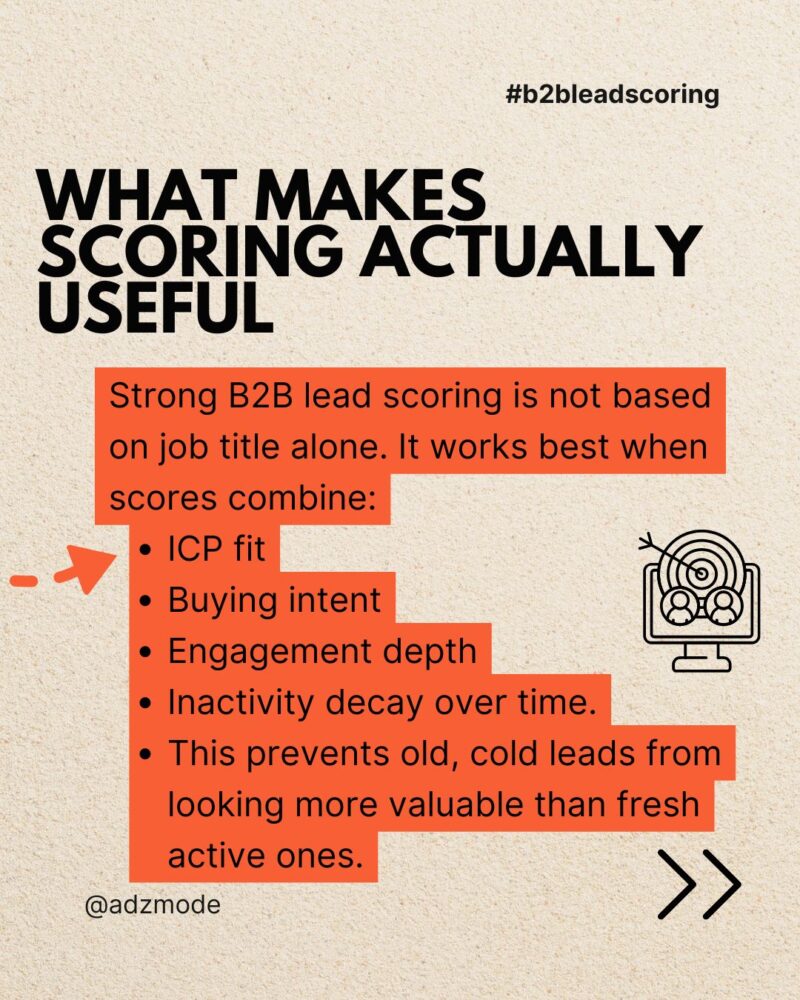
Traditional lead scoring assigns fixed point values to specific actions: 10 points for downloading a white paper and 20 for attending a webinar. It is rules-based, static, and backward-looking.
The core problem is that it measures engagement activity as a proxy for buying intent—but engagement and intent are not the same thing. A competitor downloading your content to research your scores is identical to a warm prospect actively evaluating solutions.
AI agent scoring updates in real time as new signals arrive—behavioral shifts, job changes at the account, funding news, competitive research patterns—and weights them dynamically against your ICP definition. The score reflects current truth, not historical activity.
CLICK FOR MORE
How Does Agentic AI for Marketing Differ From Marketing Automation?
Agentic AI for marketing is goal-driven, autonomous, and self-optimizing—a fundamentally different category from traditional marketing automation, which is rule-driven, reactive, and dependent on manual workflow updates.
Traditional marketing automation executes instructions: “If a lead fills out Form A, send Email B after 3 days.” Agentic AI plans, adapts, and acts: it detects a high-intent signal—a pricing page visit, a competitor comparison search, or a LinkedIn ad engagement—and immediately triggers a contextually relevant, personalized response without waiting for a human to configure the trigger.
If your marketing stack is still reacting instead of acting, it’s time to upgrade the infrastructure. Our agentic AI for marketing solutions replace manual touchpoints with intelligent, always-on systems that qualify, nurture, and convert your pipeline—autonomously. Let’s build your competitive architecture today.
The impact on pipeline velocity is measurable. Multi-agent AI systems have demonstrated a 5x outreach scale with no proportional increase in headcount. alongside significantly shorter B2B sales cycles through parallel agent execution rather than sequential human review.

What Fixes the MQL-to-SQL Handoff Problem?
The MQL-to-SQL handoff problem is fixed when both marketing and sales operate from a single, shared, machine-generated lead score rooted in ICP logic—not department-specific definitions.
When a dedicated qualifier agent applies one consistent set of criteria—budget fit, authority, explicit need, and timeline signals—to every lead, the subjective disagreement between marketing and sales disappears. There is no longer a debate about lead quality because there is no longer a human interpretation layer creating two different standards. Both teams see the same score, updated by the same logic, in real time.
How Do You Transition From a Legacy Funnel to an Agent Architecture?
You transition from a legacy funnel to an AI agent architecture in five stages, starting with your highest-friction handoff point and expanding outward.
1. Audit your current breakpoints—identify where leads stall, where handoffs fail, and where your scoring logic produces inconsistent outputs
2. Define your ICP in machine-readable logic—budget thresholds, authority signals, intent triggers, and timeline indicators must be explicit, not implicit
3. Select an orchestration layer—platforms like n8n combined with OpenAI or Claude APIs form the backbone of most practical enterprise implementations
4. Integrate with your existing CRM—the system outputs are only as clean as the data environment you route them into; a messy CRM produces unreliable routing
5. Deploy Qualification and Scoring agents first—measure pipeline quality improvement over 30–60 days, then layer in Researcher and Writer agents for full-cycle automation
Why Should B2B Owners Work With a Digital Marketing Agency for B2B?
Architecture is technical. Strategy, ICP definition, messaging calibration, and campaign intelligence are not, and getting them wrong undermines even the most sophisticated agent system.
A specialized digital marketing agency for B2B doesn’t just deploy technology—it brings the strategic layer your AI system needs to perform. We’ve calibrated AI-driven lead scoring architectures across industries, so your pipeline starts with battle-tested signal logic, not a blank learning curve. From ICP definition to full-cycle automation, we build pipelines that close.
The highest-performing B2B pipelines in 2026 combine autonomous agent infrastructure with senior strategic oversight. Technology sets the pace; strategy determines the direction. Without both, the system optimizes efficiently toward the wrong target.
What Results Can B2B Teams Expect From AI Lead Scoring?
B2B teams implementing AI agent architectures for lead scoring consistently report measurable improvements across four pipeline metrics:
- Lead quality: Significant reduction in unqualified leads reaching sales—eliminating the noise that burns out your best reps
- Pipeline velocity: Shorter sales cycles driven by parallel agent execution and faster intent-to-engagement response times
- Outreach scale: Up to 5x increase in personalized outreach volume with no proportional increase in SDR headcount
- Sales productivity: Sales reps shift from spending time scoring and routing leads to exclusively working high-priority, pre-qualified accounts
Frequently Asked Questions
Q.1 What is an AI agent architecture for B2B lead scoring?
An AI agent architecture for B2B lead scoring is a system of specialized autonomous agents—each handling one function like prospecting, qualifying, scoring, or outreach—that operate in parallel to evaluate and prioritize leads in real time, without sequential human review. Unlike static rule-based scoring, these systems reason across multiple live data sources simultaneously.
Q.2 Why do legacy sales funnels fail for B2B companies?
Legacy sales funnels fail because they were built for a linear, single-stakeholder buyer journey. Today’s B2B buyers complete up to 90% of their research independently before engaging sales, and buying decisions involve 6–10 stakeholders simultaneously. A linear funnel cannot track, score, or respond to that complexity.
Q.3 How is agentic AI different from standard marketing automation?
Standard marketing automation executes pre-built rules reactively. Agentic AI for marketing acts proactively—it detects intent signals as they emerge and triggers personalized responses autonomously, without human configuration for each scenario. It plans, adapts, and self-optimizes based on outcomes, not just predefined triggers.
Q.4 How long does it take to see results from AI lead scoring?
Properly configured multi-agent lead scoring systems typically show measurable pipeline quality improvement within 30–60 days of deployment, as the qualification logic calibrates against your live pipeline data. ROI compounds over time as the system accumulates proprietary signal history from your specific market and ICP.
Q.5 Do I need to replace my entire marketing tech stack to implement this?
No. Most AI agent architectures are designed to layer on top of existing CRM and marketing automation tools. They act as an intelligent orchestration layer—pulling data from your existing systems, reasoning across it, and routing enriched, scored leads back into the platforms your team already uses.
Q.6 Is this approach only viable for enterprise B2B companies?
No. While enterprise teams were early adopters, current agentic platforms built on modular APIs and accessible orchestrators like n8n make multi-agent lead scoring practical for mid-market and growth-stage B2B companies. The key is starting narrow—deploying qualification and scoring agents first—and expanding the architecture as results validate the investment.
custom marketing automation systems for quality leads
The Pipeline Isn’t the Problem. The Architecture Is
AI agent architectures for B2B lead scoring don’t patch a broken funnel—they replace the structural assumption that a linear model can process a non-linear buyer. The modern B2B pipeline needs systems that reason in real time, operate autonomously across every stage, and surface intelligence that your sales team can act on immediately—not retrospectively. The companies winning the most competitive B2B markets in 2026 are not the ones with the largest sales teams. They are the ones with the most intelligent pipeline infrastructure.
About the Author: Harleen Kaur

Mrs. Harleen is a Digital Marketing professional and Gen AI SEO expert based in New Delhi. Academically backed by an IIT Digital Marketing Certification and two prestigious IBM credentials — Gen AI Certified for Digital Marketing and a Master's in Gen AI SEO — Harleen specialises in helping businesses grow their digital presence using the latest AI-driven strategies. Her insights are grounded in both technical expertise and real-world application. Prompting essentials from IBM.
Share Your Project Requirements With Us