
Healthcare and marketing have always shared a complicated relationship. You want to grow—reach more patients, fill more appointment slots, build a brand that people actually trust—but the rulebook governing how you do it is thick, technical, and unforgiving. One wrong claim, one unvetted ad, and you’re not just burning ad spend—you’re risking regulatory fines, patient distrust, and serious reputational damage.
Here’s the good news: compliance and performance are not opposites. With the right paid marketing strategies for healthcare brands, you can scale aggressively while staying completely on the right side of the law. Let’s break it down in a way that actually makes sense.
Why Healthcare Paid Marketing Is a Different Beast?
Most industries can get away with bold claims, emotional urgency, and aggressive CTAs. Healthcare? Not so much.
The digital landscape for healthcare marketing is constantly evolving, and maintaining compliance with regulations like HIPAA has become more critical than ever—especially as we move through 2026. Healthcare providers must understand how recent policy updates and platform changes affect their paid advertising strategies, particularly around patient privacy and data handling.
Here’s what makes healthcare marketing uniquely challenging:
- Strict data laws: HIPAA requires that patient information—even indirect identifiers—is never used in ad targeting without proper consent.
- Platform-level restrictions: Google’s Healthcare & Medicines Ads Policy restricts content around unapproved treatments, prescription drugs, and misleading health claims.
- FTC and FDA oversight: In the US, both the FTC and FDA prohibit misleading health claims; all outcome-based messaging must be backed by clinical evidence or regulatory-approved data.
- ASCI and MCI guidelines in India: The Advertising Standards Council of India (ASCI) and the Medical Council of India (MCI) prohibit false testimonials, guaranteed cure claims, and comparative advertising that undermines medical ethics.
None of this means you can’t market effectively. It simply means that how you market matters as much as how much you spend.
The Real ROI of Healthcare Paid Marketing (When Done Right)
Still wondering if the investment is worth it? Consider this: a medical practice using HIPAA-compliant paid advertising techniques can see average ROI figures of anywhere between 4x to 24x on their marketing spend, depending on the specialty and patient lifetime value. One urgent care chain running compliant Google Ads, Facebook Ads, and SEO together grew from 401 patients per month to over 1,000 in just eight months.
That kind of growth doesn’t happen by accident—it happens through smart, compliant, data-informed paid marketing. And once you build a system that respects the rules while maximizing reach, the results are genuinely compounding.
Compliance-Safe Paid Marketing Strategies for Healthcare Brands
1. Lead With Education, Not Claims
The golden rule in healthcare advertising: inform first, sell second. Instead of “We cure diabetes,” you run an ad that says “Know your diabetes risk—book a free screening.” Instead of “Best heart hospital in India,” you go with “Understanding your cardiac health: expert consultations now available.”
This shift in approach isn’t just ethical—it’s strategic. Educational ads pass platform compliance checks more easily, resonate better with cautious healthcare consumers, and generate higher quality leads. Patients who click on informational content are often further along in their decision-making journey, which means better conversion rates once they land on your page.
Pro tip: Use Google’s responsive search ads (RSAs) to test compliant headline and description combinations automatically. The algorithm finds the best-performing version—within your approved copy set.
2. Smart Audience Targeting Without Touching PHI
This one trips up a lot of healthcare brands. You want to reach the right people—but in healthcare, targeting by health condition or patient status is a direct HIPAA red flag.
Here’s how to do it right:
- Target by symptoms or intent, not diagnosis. For example, target “back pain relief” rather than “back pain patients.”
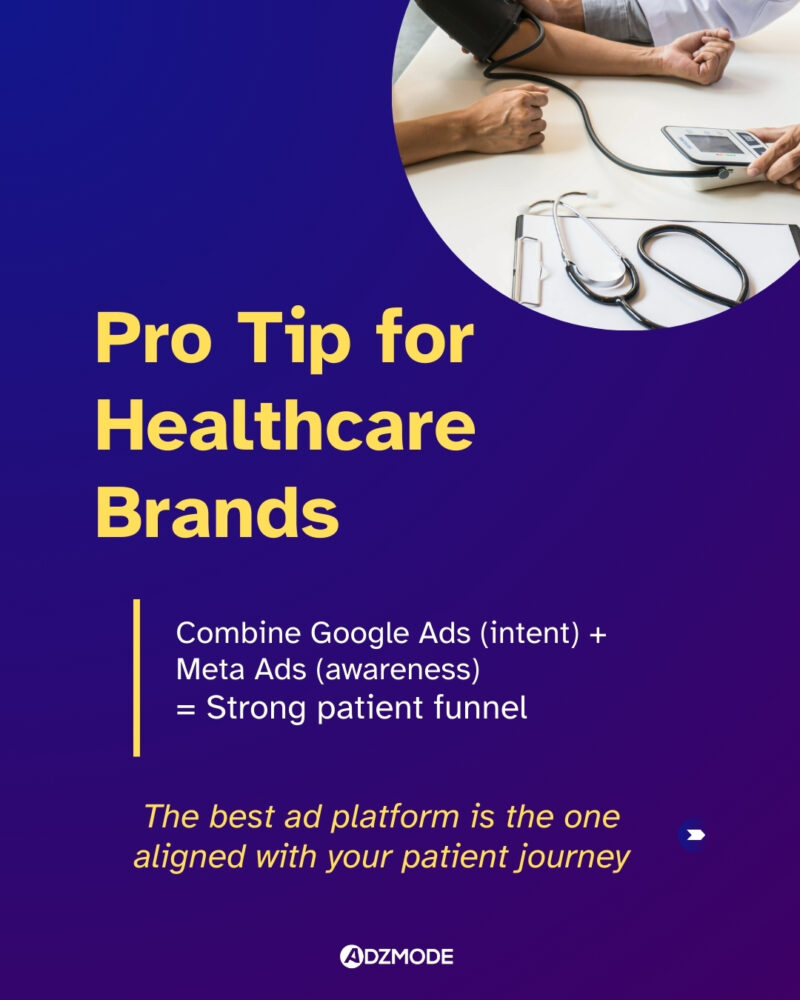
- Use in-market audience segments that Google and Meta build based on browsing behavior—not health records.
- Geo-targeting with demographic overlays is powerful and compliant: target by location, age group, and general health interest—nothing that identifies someone as a patient.
- Never upload patient email lists to ad platforms without verified, documented consent.
The key here is that intent-based targeting replaces condition-based targeting—and surprisingly, it performs just as well (often better) because it reaches people while they’re actively seeking help.
social media to boost medical practice
3. HIPAA-Safe Tracking and Analytics Setup
Most healthcare brands assume their Google Ads tracking is compliant out-of-the-box. It isn’t. Google doesn’t sign a Business Associate Agreement (BAA) with healthcare advertisers, which means standard conversion tracking can inadvertently capture Protected Health Information (PHI) through URL parameters or page titles.
To run fully compliant campaigns:
- Redact PHI from all conversion events. Strip any sensitive data from page URLs, form submissions, and tracking parameters before they reach Google or Meta pixels.
- Use server-side tagging instead of browser-side pixels where possible—it gives you more control over what data is shared with third-party platforms.
- Enable Google Consent Mode and Meta’s Consent API to ensure user data is collected only with verified opt-in.
- Use HIPAA-compliant analytics platforms designed specifically for healthcare data environments.
Getting this infrastructure right is unglamorous work—but it’s the foundation everything else is built on.

4. Retargeting Without Crossing the Line
Retargeting is one of the most powerful tools in digital advertising, and yes—healthcare brands can use it. But the rules are strict, and the boundaries matter.
Compliant retargeting in healthcare works like this:
- Retarget based on website behavior, not health data. Someone who visited your “book a consultation” page is fair game. Someone who searched “cancer treatment” is not.
- Use anonymous or hashed audience segments rather than identifiable data.
- Segment by content interaction: did they download a health guide? Watch a video about a procedure? Those are safe, consent-friendly retargeting triggers.
- Always include easy opt-out options in your ads and landing pages.
Done right, retargeting in healthcare can dramatically reduce your cost per acquisition by re-engaging high-intent visitors who just needed a little more time.
5. Work With the Right Performance Marketing Partner
Here’s where a lot of healthcare brands leave serious money on the table—they either run campaigns internally without specialized compliance knowledge, or they hand over budgets to generalist agencies that don’t understand healthcare’s unique regulatory terrain.
This is exactly where experienced performance marketers become your brand’s biggest asset.
If you’re a healthcare brand spending on Google Ads, Meta, LinkedIn, or programmatic channels, and you’re not working with performance marketers who specialize in healthcare compliance, you’re either overspending, under-converting, or quietly sitting on a compliance violation you don’t even know about yet.
The right performance marketing partner will audit your current setup, rebuild tracking the right way, create compliant ad copy that still converts, and deliver measurable ROI without the legal risk. Think of it as having a co-pilot who knows both the flight plan and the air traffic control regulations inside out.
Ready to scale your healthcare brand through campaigns that are built to convert and built to last? It’s time to work with performance marketers who understand the healthcare ecosystem—not just the ad platform.

6. Video Advertising: Healthcare’s Most Underused Format
Video ads on YouTube and Meta are massively underutilized by healthcare brands—and that’s actually an opportunity for those willing to step in.
Short-form video content (15–30 seconds) featuring a real doctor, a patient journey story, or a walkthrough of a procedure builds trust at a speed that no banner ad can match. Key compliance considerations for video:
- Include appropriate disclaimers (“Results may vary,” “Consult your physician”).
- Never feature patient testimonials without signed, written consent and FTC-compliant disclosure.
- Avoid before-and-after imagery for serious medical conditions—both Google and Meta flag this.
- Keep claims evidence-based; don’t say “the best,” “guaranteed,” or “proven” without verifiable data to back it up.
A telehealth platform that paired targeted Facebook video ads with email automation sequences managed to slash its cost per acquisition by 40% and double ROI within six months. The secret? Creative that educated, not just promoted.
7. Local Service Ads and PPC for Patient Acquisition
If you’re a hospital chain, clinic, or diagnostic center operating across multiple cities, Google Local Service Ads (LSAs) and location-specific PPC campaigns are non-negotiable.
LSAs put your brand right at the top of Google search—above even standard paid ads—for hyperlocal, high-intent searches like “cardiologist near me” or “blood test lab in Pune.” They’re built for trust: your ad shows Google’s verification badge, your ratings, and your contact details.
Best practices for compliant healthcare PPC:
- Use negative keywords aggressively—filter out terms like “free,” “home remedy,” or unrelated conditions.
- Match landing page content exactly to the ad’s promise—no bait-and-switch.
- Include disclaimers and credentials prominently on the landing page.
- Test call-only ads for specialties where appointment calls are the primary conversion goal.
8. Your Landing Page Is Half the Campaign
You could run the most compliant, high-quality ad in the world—and lose every lead because your landing page is slow, cluttered, or unconvincing. In healthcare, trust signals on your landing page aren’t optional—they’re conversion essentials.
Here’s what every healthcare landing page needs:
- Doctor credentials and photos (real, not stock)
- Certifications, accreditations, and hospital affiliations prominently displayed
- Privacy policy and data use disclosures are visible and easy to find
- Patient reviews (with consent) or aggregate rating displays
- Clear, soft CTAs — “Book a Free Consultation” converts better than “Buy Now” in healthcare
- Page speed under 3 seconds — bounce rates spike dramatically after that threshold
This is exactly where the design and development of your website becomes a revenue-critical decision—not just an aesthetic one.
If your healthcare brand’s website isn’t built to convert compliant traffic into actual patients, you’re wasting every rupee you put into paid campaigns. Partnering with a specialized web design company in India means getting healthcare-grade UX, HIPAA-conscious page architecture, and high-speed design at a fraction of global agency costs—so every ad click lands on a page that actually works.

9. Content-Backed Paid Campaigns (The Trust Multiplier)
One of the smartest long-term plays in healthcare paid marketing is using your content as the ad itself. Rather than sending traffic directly to a service page, run paid campaigns that promote genuinely useful content—a symptoms guide, a patient FAQ video, a downloadable wellness checklist.
Why it works:
- Lower CPCs because the content is educational, not promotional
- Higher time-on-site and lower bounce rates
- Builds email lists through gated content without violating data laws (with proper consent)
- Warms up cold audiences who aren’t ready to book but will be
Then you retarget the people who engaged with that content—compliantly—with a softer CTA like “Ready to talk to a specialist?” This nurture-based funnel approach is how smart healthcare brands build patient pipelines that don’t dry up.
10. Compliance Audits: Not Just a Checkbox
Compliance isn’t a one-time setup—it’s an ongoing process. Platforms update their policies, regulations evolve, and your campaign structure needs to keep up. A quarterly compliance audit of your paid marketing should include:
- Reviewing all active ad copy for unverified claims or sensitive language
- Checking landing page disclaimers and privacy notices are current
- Auditing tracking tags and pixels for PHI exposure
- Verifying consent flows on all lead generation forms
- Reviewing audience segments for any policy-sensitive categories
Think of this like a routine health check-up. Preventive. Affordable. And far less painful than dealing with the alternative.
Common Compliance Mistakes Healthcare Brands Keep Making
Even well-intentioned marketing teams slip up. Watch out for these:
- Guaranteed results language: “100% cure” or “guaranteed recovery” will get ads rejected and may invite regulatory scrutiny.
- Using patient data for lookalike audiences without explicit, documented consent.
- Unverified review schemes: Soliciting or buying fake reviews carries FTC penalties.
- Unsecured landing pages: If your landing page URL starts with “http://” instead of “https://,” you’re failing both compliance and trust standards.
- Skipping disclaimer copy on any ad that references outcomes, treatments, or medical procedures.
digital marketing success in pharma industry
FAQ: Paid Marketing Strategies for Healthcare Brands
Q1. Can healthcare brands legally run retargeting ads?
Yes, but only when retargeting is based on website behavior—not health conditions or patient data. Use consent-based pixels and clear opt-out options to stay compliant.
Q2. Which platforms work best for healthcare paid marketing?
Google Ads (Search and Display), YouTube, LinkedIn (for B2B healthcare), and Meta are the most effective. Each has specific healthcare ad policies that must be followed.
Q3. Is it safe to use patient testimonials in healthcare ads?
Only with explicit written consent from the patient and FTC-compliant disclosure. Testimonials must accurately reflect typical results—you can’t cherry-pick dramatic outcomes.
Q4. How do I track healthcare ad conversions without violating HIPAA?
Use server-side tagging, redact PHI from all conversion events, and consider HIPAA-compliant analytics tools built for healthcare environments. Avoid standard Google Ads conversion tracking without proper configuration.
Q5. How much should a healthcare brand spend on paid marketing?
There’s no universal number, but well-optimized healthcare campaigns have shown ROI of 4x to 24x depending on specialty and patient lifetime value. Start with a test budget, measure cost per acquisition, and scale what works.
Conclusion
Here’s the thing about compliance-safe paid marketing for healthcare brands—it’s not about limiting your ambition. It’s about channeling it in a direction that lasts. Brands that build their paid marketing on a foundation of trust, transparency, and regulatory respect don’t just avoid fines—they build patient relationships that compound over time.
The healthcare brands winning in 2026 aren’t the loudest. They’re the ones that show up with the right message, on the right platform, to the right audience—without cutting corners on ethics or compliance. That combination of discipline and creativity is exactly what separates brands that grow sustainably from those that burn bright and burn out.
Start building that foundation today.
Share Your Project Requirements With Us